
Overview
Introduction
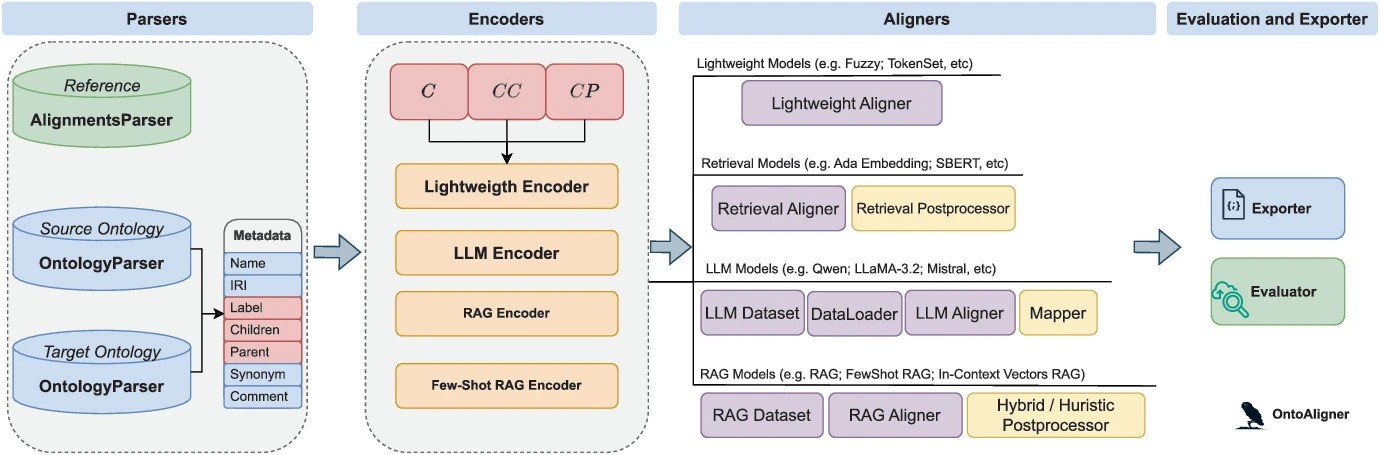
OntoAligner is a modular, extensible, and efficient framework for ontology alignment that integrates classical heuristics, retrieval-based methods, and large language models (LLMs). It is designed to support a wide range of ontology alignment (OA) scenarios—from lightweight matching to advanced semantic reasoning—with built-in support for evaluation and export.
The Parser module serves as the entry point of OntoAligner, handling ontology ingestion and alignment data loading. Key components include:
OntologyParserthat supports loading ontologies and extracts class/property names, IRIs, hierarchies, synonyms, annotations, and any relevant informations.AlignmentsParserfor loading ground truth alignments used for evaluation. However, in cases where a specific dataset does not support references, this module may be ignored.
Note
🔧 Checkout parsers at Developer Guide > Parsers
After parsing, the Encoder module transforms ontological concepts into structured representations suited for similarity estimation or prompt-based inference given the nature of aligner model. Here are few list of supported encoders:
Lightweight Encoder: Combines concept metadata (Concept, Children, Parent) into simple natural language strings for heuristic-based aligners.
LLM Encoder: Prepares structured prompt-compatible inputs for language models, extracting and formatting parent-child relationships per concept.
RAG Encoder: Tailored for Retrieval-Augmented Generation (RAG)-based alignment using in-context vectors (ICV) to support few-shot and in-context learning setups.
Each encoder is pluggable and configurable, allowing flexible adaptation to different use cases.
The Aligner Module is the core of OntoAligner and is responsible for discovering mappings between entities in two ontologies. It includes a diverse suite of alignment algorithms grouped into different categories: Lightweight, Retrieval, LLM, RAG, etc.
Aligner |
Description |
|---|---|
Lightweight Aligners |
Fast, heuristic-based methods using fuzzy matching and token similarity with configurable thresholds. Suitable for large-scale, low-complexity tasks. |
Retrieval Aligners |
Machine learning-based methods using vector representations: |
LLM Aligners |
Uses pretrained LLMs from HuggingFace to evaluate alignment based on natural language prompts. Offers strong semantic alignment for small-scale ontologies (≤200 concepts) due to quadratic complexity. |
RAG Aligners |
A hybrid approach that enhances accuracy by combining retrieval and LLM reasoning. Retrieves contextual information. Computes alignment decisions using logit-based scoring instead of generation. Reduces GPU usage with single forward-pass inference. |
Fully modular and extendable to accommodate custom post-alignment techniques.
Mapper: Maps generated texts (e.g., LLM outputs) to ontology classes.
Filtering: Applies heuristic and rule-based strategies to ensure consistency and precision.
📈 Evaluator: Computes standard OA metrics: Precision, Recall, and F1-score. Supports comparison across different aligners and configurations.
📤 Exporter: Supports alignment export in common formats: XML and JSON.
Usage
You can install OntoAligner using pip:
pip install -U OntoAligner
See installation for further installation options.
See the Quickstart for more quick information on how to use OntoAligner.
Working with OntoAligner is straightforward:
from ontoaligner.ontology import MaterialInformationMatOntoOMDataset
from ontoaligner.utils import metrics, xmlify
from ontoaligner.aligner import MistralLLMBERTRetrieverRAG
from ontoaligner.encoder import ConceptParentRAGEncoder
from ontoaligner.postprocess import rag_hybrid_postprocessor

# Step 1: Initialize the dataset object for MaterialInformation MatOnto dataset
task = MaterialInformationMatOntoOMDataset()
print("Test Task:", task)

# Step 2: Load source and target ontologies along with reference matchings
dataset = task.collect(
    source_ontology_path="assets/MI-MatOnto/mi_ontology.xml",
    target_ontology_path="assets/MI-MatOnto/matonto_ontology.xml",
    reference_matching_path="assets/MI-MatOnto/matchings.xml"
)

# Step 3: Encode the source and target ontologies
encoder_model = ConceptParentRAGEncoder()
encoded_ontology = encoder_model(source=dataset['source'], target=dataset['target'])

# Step 4: Define configuration for retriever and LLM
retriever_config = {"device": 'cuda', "top_k": 5,}
llm_config = {"device": "cuda", "max_length": 300, "max_new_tokens": 10, "batch_size": 15}

# Step 5: Initialize Generate predictions using RAG-based ontology matcher
model = MistralLLMBERTRetrieverRAG(retriever_config=retriever_config, llm_config=llm_config)
model.load(llm_path = "mistralai/Mistral-7B-v0.3", ir_path="all-MiniLM-L6-v2")
predicts = model.generate(input_data=encoded_ontology)

# Step 6: Apply hybrid postprocessing
hybrid_matchings, hybrid_configs = rag_hybrid_postprocessor(predicts=predicts,
                                                            ir_score_threshold=0.1,
                                                            llm_confidence_th=0.8)

evaluation = metrics.evaluation_report(predicts=hybrid_matchings, references=dataset['reference'])
print("Hybrid Matching Evaluation Report:", evaluation)

# Step 7: Convert matchings to XML format and save the XML representation
xml_str = xmlify.xml_alignment_generator(matchings=hybrid_matchings)
open("matchings.xml", "w", encoding="utf-8").write(xml_str)
What is Next?
Quickstart:
How to dive quickly into ontology alignments? Getting Started > Quickstart.
Developer Guide:
How to parse ontologies for ontology aligment? Developer Guide > Parsers.
Aligner Techniques:
How to use Lightweight Aligner? Aligners > Lightweight
How to use Retrieval Aligner? Aligners > Retrieval
How to use Large Language Model Aligner? Aligners > Large Language Model
How to use Retrieval Augmented Generation Aligner? Aligners > Retrieval Augmented Generation
Use Casses:
How OntoAligner can be used in e-Commerce? Use Cases > eCommerce